In the main frieze is a battle between Greeks and barbarians; at the left end stand two griffins. The irregular field above the frieze shows deer being killed, one by a lion, the other by a griffin. The scabbard from which this gold decoration came would have been of another material, possibly bronze or iron. Such an elaborately embellished scabbard would have formed part of a ceremonial set of Scythian weapons typically including a sword, a bow, and a bow sheath. The Scythians were a nomadic people who lived in the Eurasian steppes during the first millennium B.C. Although the scabbard is of Scythian type, the decoration is Greek in style and undoubtedly of Greek workmanship. Similar sheet-metal goldwork from the royal cemetery at Vergina in northern Greece and from kurgans (burial mounds) of Scythian rulers in the North Pontic region (around the Black Sea) have been linked to the same workshop.


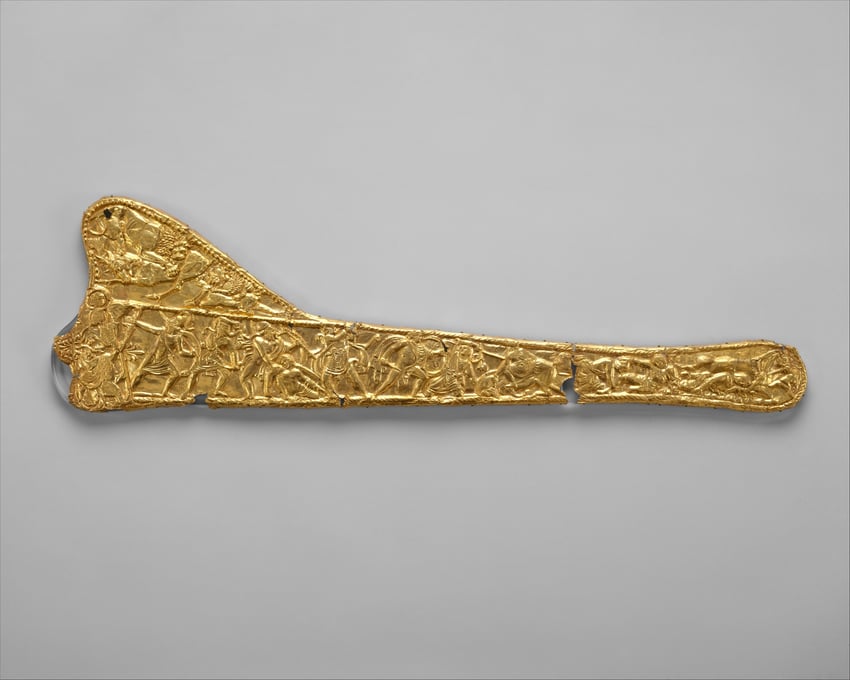
Sheet-gold decoration for a sword scabbard
Greek or Scythian
ca. 340–320 BCE
In the main frieze is a battle between Greeks and barbarians; at the left end stand two griffins. The irregular field above the frieze shows deer being killed, one by a lion, the other by a griffin.
The scabbard from which this gold decoration came would have been of another material, possibly bronze or iron. Such an elaborately embellished scabbard would have formed part of a ceremonial set of Scythian weapons typically including a sword, a bow, and a bow sheath. The Scythians were a nomadic people who lived in the Eurasian steppes during the first millennium B.C. Although the scabbard is of Scythian type, the decoration is Greek in style and undoubtedly of Greek workmanship. Similar sheet-metal goldwork from the royal cemetery at Vergina in northern Greece and from kurgans (burial mounds) of Scythian rulers in the North Pontic region (around the Black Sea) have been linked to the same workshop.
Credit: The MET Museum