The statuette, made of Chinese porcelain in turquoise glaze, represents a cat seated on his hind legs. The animal’s pose—turning towards the viewer, with its tail curled against its thigh—is traditionally found in eighteenth-century Chinese porcelain for chimeras, guardian lions, and parrots, which typically occur in pairs facing each other. A hole on the lower part of the animal’s spine suggests that it could have served as an incense burner, which could be placed underneath its fully opened base before this access was covered by the later addition of the cushion. Created in early eighteenth-century China for export to Europe, the cat was adorned in mid-eighteenth-century France with elements of gilded bronze. It was installed on a low, rectangular stool raised on four balustrade-shaped legs, on top of a richly decorated cushion. Eyes in enameled glass were also added to the animal. Such an expressive animal in colorful Chinese glazed porcelain and elaborately enriched with French gilt bronze elements characterizes a type of highly desirable object sought by some of the most discerning collectors of eighteenth-century Europe, including the Marquise de Pompadour, who owned this artwork.


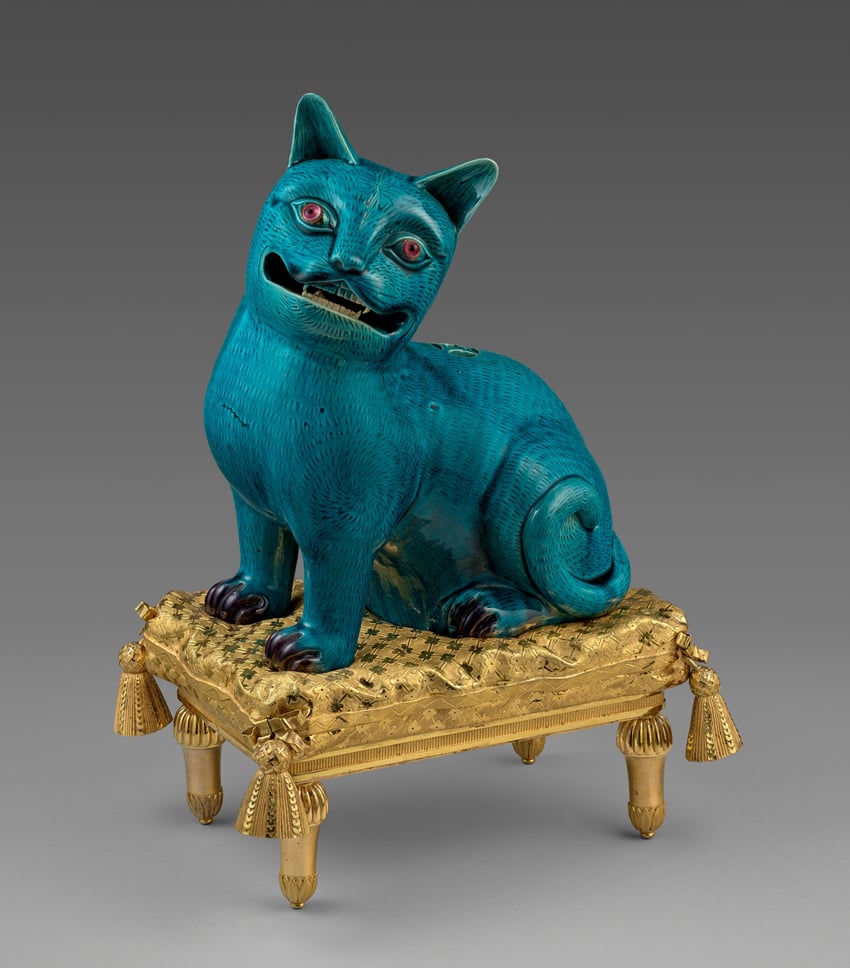
Cat
The statuette, made of Chinese porcelain in turquoise glaze, represents a cat seated on his hind legs. The animal’s pose—turning towards the viewer, with its tail curled against its thigh—is traditionally found in eighteenth-century Chinese porcelain for chimeras, guardian lions, and parrots, which typically occur in pairs facing each other. A hole on the lower part of the animal’s spine suggests that it could have served as an incense burner, which could be placed underneath its fully opened base before this access was covered by the later addition of the cushion. Created in early eighteenth-century China for export to Europe, the cat was adorned in mid-eighteenth-century France with elements of gilded bronze. It was installed on a low, rectangular stool raised on four balustrade-shaped legs, on top of a richly decorated cushion. Eyes in enameled glass were also added to the animal. Such an expressive animal in colorful Chinese glazed porcelain and elaborately enriched with French gilt bronze elements characterizes a type of highly desirable object sought by some of the most discerning collectors of eighteenth-century Europe, including the Marquise de Pompadour, who owned this artwork.