Stirrup-spout bottle with warclub and crab warrior
This vessel shape is a variant on a common type known as a stirrup-spout bottle—the shape of the spout recalls the stirrup on a horse's saddle—and it was a much-favored form on Peru's northern coast for about 2,500 years. Although the importance and symbolism of this distinctive shape remains puzzling to scholars, it has been suggested that the double-branch/single-spout configuration may have prevented evaporation of liquids, and/or that it was convenient for carrying. Early in the first millennium CE, the Moche elaborated stirrup-spout bottles into sculptural shapes depicting a wide range of subjects, including human figures, animals, and plants worked with a great deal of naturalism. About 500 years later, bottle chambers became predominantly globular, as above, providing large surfaces for painting complex multi-figure scenes.
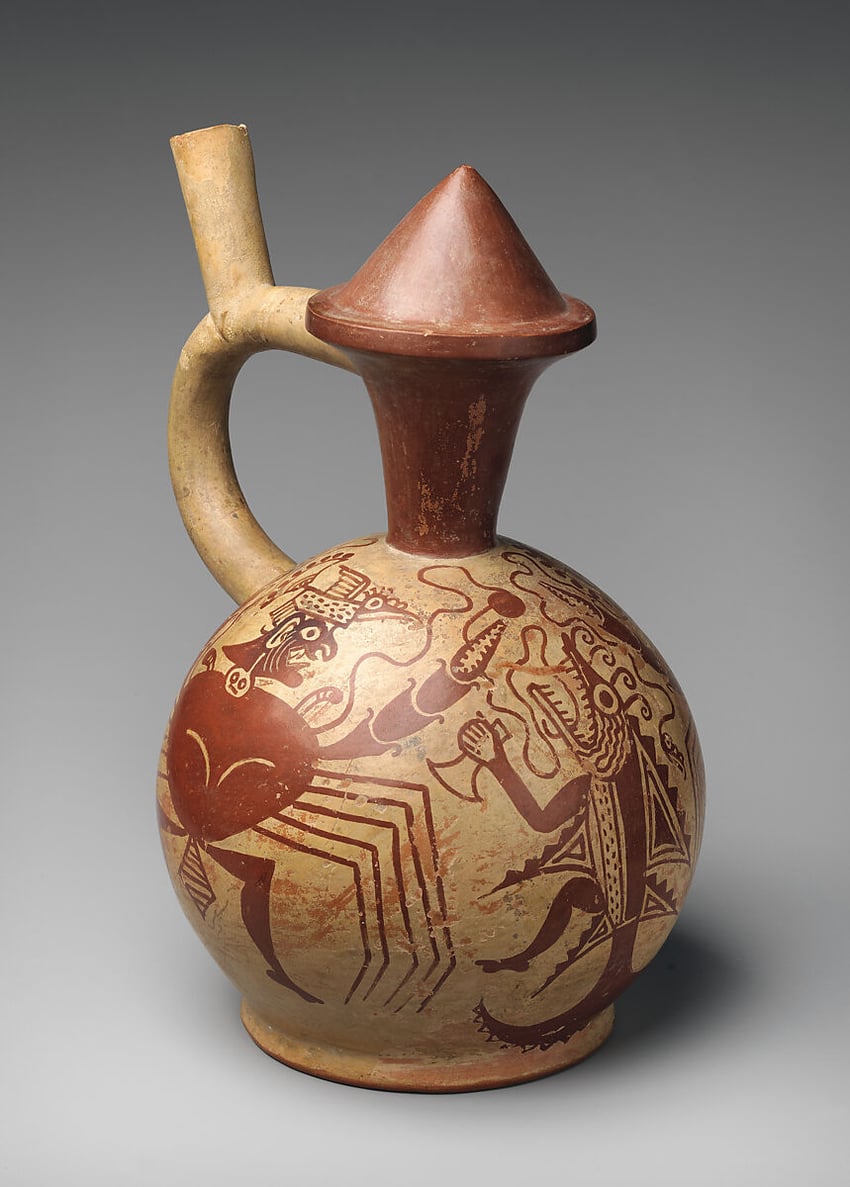
On this particular vessel, the spout was moved to the side and the long-necked bottle shape sculpted into a novel depiction of a mace head with a painted scene below. Scholars refer to this painting style as “fineline” for the detailed figures and scenes delicately slip-painted in red on a white background (slip is a suspension of clay and/or other colorants in water).


Stirrup-spout bottle with warclub and crab warrior
This vessel shape is a variant on a common type known as a stirrup-spout bottle—the shape of the spout recalls the stirrup on a horse's saddle—and it was a much-favored form on Peru's northern coast for about 2,500 years. Although the importance and symbolism of this distinctive shape remains puzzling to scholars, it has been suggested that the double-branch/single-spout configuration may have prevented evaporation of liquids, and/or that it was convenient for carrying. Early in the first millennium CE, the Moche elaborated stirrup-spout bottles into sculptural shapes depicting a wide range of subjects, including human figures, animals, and plants worked with a great deal of naturalism. About 500 years later, bottle chambers became predominantly globular, as above, providing large surfaces for painting complex multi-figure scenes.
On this particular vessel, the spout was moved to the side and the long-necked bottle shape sculpted into a novel depiction of a mace head with a painted scene below. Scholars refer to this painting style as “fineline” for the detailed figures and scenes delicately slip-painted in red on a white background (slip is a suspension of clay and/or other colorants in water).